


 RSS feed for Colin Smith
 @Colin_TBTAMC
ON COMICS CHARACTERS


ON SCI-FI FRANCHISES





ON GRANT MORRISON



ON TV AND MOVIES





OTHER BOOKS




DOCUMENTARY FILMS




Colin Smith is currently Q Magazine’s comics columnist and blogs at Too Busy Thinking About My Comics and on Tumbler.
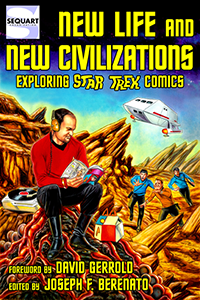 New Life and New Civilizations: Exploring Star Trek Comics (contributor) |
 Shameless? The Super-Hero Comics of Mark Millar: Part 1, An Introduction
It’s too good a story not to be treated with suspicion. Asked to recall his first comic by Lee Randall of The Scotsman in 2009, Mark Millar declared that he could remember the matter “exactly”.… [more]
 On the Profoundly Rational Doctor Stephen Strange
Who’d pitch a character such as Steve Ditko and Stan Lee’s Doctor Strange to one of the Big Two today?
 The Adventures of Henry Pym (1962 to 1965)
Don’t print the legend. There was no such thing as an archetypal “Marvel superhero” for the first few years following the publication and unexpected success in 1961 of the Fantastic Four. What would in hindsight… [more]
 On Hawkworld, by Timothy Truman and Alcatena (1989)
In the shadows of the planet Thanagar’s great High Towers, where the three billion souls of the Empire’s alien underclass are segregated away in the most squalid and soul-butchering of conditions, there’s a statue of… [more]
 Dan Dare and the Seductive Myths of Englishness
In the very first Dan Dare adventure, which began to be serialised weekly in the Christian boy’s comic Eagle in 1950, we’re introduced to the ”Inter Planet Space Fleet some years in the future.”
 He’s Not a Super-Hero, He’s Not Even a Very Naughty Boy: The Case Against Grant Morrison and Steve Yeowell’s Zenith
He’s a bad one, that Zenith, and we can be sure about that badness because the people who know assure us that it’s true.
 The Challenge of the Super-Friends: Why Warren Ellis and Bryan Hitch’s The Authority is One of the Sweetest Comics of the Modern Era
For a comic book characterised by its “intense graphic violence” (according to Wikipedia) and designed to be marked by an “attention to nasty little details, its appalling bad attitude, and the utter carnage the cast are capable… [more]
 Unashamed: In Which Concluding Remarks are Made and a Book is Announced, Shameless? The Superhero Tales of Mark Millar
I hate to break a promise, even if it’s made to no-one but myself. Yet things have changed since I typed “to be continued” at the foot of the last section of Shameless? to be… [more]
 “New Paradigms for the Super Hero Team Structure?”: On Skrull Kill Krew #1-5 (The American Superhero Comics of Mark Millar, Part 45)
Continued from last week. No-one could accuse Morrison of being blind to Skrull Kill Krew’s satirical potential. In 1995, he spoke enthusiastically of the book’s capacity to discuss the likes of “catastrophy in the 20th… [more]
 “Until It Destroys Your Brain”: On Skrull Kill Krew #1-5 (The American Superhero Comics of Mark Millar, Part 44)
Continued from last week. Not everything in Morrison and Millar’s rebuffed pitches to Marvel went to waste. The former’s dogged belief in the quality of the Apocalypse 2099 proposal would have only been strengthened by… [more]
 “It Would Have Made a Great Comic”: On Skrull Kill Krew #1-5 (The American Superhero Comics of Mark Millar, Part 43)
Continued from last week. Yet whatever its strengths, Morrison and Millar’s 2099 proposal went to waste, with a far less sweeping and less nostalgic series of changes being introduced instead. As part of the ongoing… [more]
 On Doctor Who: New Adventures with the Eleventh Doctor & the Often-Ignored Virtues of the Licensed Comic
Concerning the first 8 pages of Al Ewing, Rob Williams, Simon Fraser & Gary Caldwell’s Doctor Who #1 (2014) The quality of licensed comics has never been higher, and yet some still regard them with… [more]
 “A Fading 2099 Universe”: On Skrull Kill Krew #1-5 (The American Superhero Comics of Mark Millar, Part 42)
Continued from last week. The problem with Skrull Kill Krew obviously wasn’t a lack of ambition on Morrison and Millar’s part. The same was true for several of their other substantial pitches to Marvel during… [more]
 “To Shoot Every Last Skrull On Earth”: On Skrull Kill Krew #1-5 (The American Superhero Comics Of Mark Millar, Part 41)
Continued from last week. Despite the precipitous collapse and subsequent flatlining of Swamp Thing’s sales in the second half of 1994, Millar’s career at the half-point of the decade still appeared to be in rude… [more]
 “About Sixty Per Cent Happy”: The American Superhero Comics of Mark Millar, Part 40
Continued from last week. The rest of Millar’s Swamp Thing tales shared the same weaknesses as River Run, although they only intermittently reflected the same strengths. The likes of Twilight of The Gods and Chester… [more]
 “So Many Questions are Left Unanswered”: The American Superhero Comics of Mark Millar, Part 39
Continued from last week. For the third time in ten months, Millar’s Swamp Thing had presented abortion in a wholly negative light. Nothing that he’d write in the remainder of his tenure on the book… [more]
 “Why d’You Think God Created Abortion Clinics?”: The American Superhero Comics of Mark Millar, Part 38
Continued from last week. After abortion as a vehicle for laddish jokes and abortion as a means for evoking terror, Millar turned to abortion as a symbol of crass irresponsibility. (ST: 147/152/157) In Sink Or… [more]
 “Terminate This Pregnancy”: The American Superhero Comics of Mark Millar, Part 37
Continued from last week. Millar makes more use of the topic of abortion in Swamp Thing than most superhero writers do in a lifetime. In each case, abortion is used either as a symbol of… [more]
 “Her Deepest, Hidden Secrets”: The American Superhero Comics of Mark Millar, Part 36
Continued from last week. As so often before, Murder In The Dark saw Millar indulging in two of his greatest fascinations: body horror at the expense of helpless female victims and the tradition and dogma… [more]
 “Do You Remember Earth Two or Earth X?”: The American Superhero Comics of Mark Millar, Part 35
Continued from last week. Though Millar’s River Run tales are rarely anything other than predictable, they’re also undeniably focused, purposeful and enthusiastically told. Even when he’s sketching out the inevitably baleful career of a psychopathic… [more]
 “There is Something Wrong with This World”: The American Superhero Comics of Mark Millar, Part 34
Continued from last week. Even when Millar put an appropriately exotic backdrop to use, he frequently neutered its dramatic potential. The desert setting used to conclude the first arc was portrayed in an entirely throwaway… [more]
 “Not Walking in Alan Moore’s Footsteps”: The American Superhero Comics of Mark Millar, Part 33
Continued from last week. Of course, there’s no reason why an obvious ending can’t also be a satisfying one. Similarly, a protagonist that seems to lack personality or potency can still be used in a… [more]
 “Even The Worst Among Them Has Potential”: The American Superhero Comics of Mark Millar, Part 32
Continued from last week. So, the Millar who wrote Swamp Thing was enthusiastic, ambitious, and ethically engaged. But for all his efforts and good intentions, and for all the occasional highpoint, the run was heavy-handed,… [more]
 “Ritual Must Be Observed”: The American Superhero Comics of Mark Millar, Part 31
Continued from last week. As for his two warring Lodges of super-mages, Millar seems to have used them as a symbol of religious sectarianism and reconciliation. Their differing interpretations of how to save the world… [more]
 “Why Try to Create a New God?”: The American Superhero Comics of Mark Millar, Part 30
Continued from last week. But for all the carelessness and clumsiness of Millar’s scripts, his and Morrison’s Swamp Thing consistently displays a deliberate and serious moral purpose. Indeed, the comic persistently plays out two quite… [more]
 “Take a Look Inside My Mind”: The American Superhero Comics of Mark Millar, Part 29
Continued from last week. It’s impossible to believe that Morrison and Millar’s Swamp Thing wasn’t intended as an allegory. For all that Morrison’s original plans appear to have been significantly modified by his junior partner,… [more]
 “Old Souls, Dark Agendas”: The American Superhero Comics of Mark Millar, Part 28
Continued from last week. The final pages of Millar’s Swamp Thing depict the Earth on the eve of a historically unprecedented golden age. (*1) Humanity has been empathetically transformed through the god-like Swamp Thing’s influence,… [more]
 “The Spirit of Hatred or the Spirit of Love”: The American Superhero Comics of Mark Millar, Part 27
Continued from last week. Other aspects of Millar’s closing tilt at Swamp Thing were less praiseworthy. Though the final arc appears to show little of the swaggering misogyny that saturated his earliest work for 2000AD,… [more]
 “The Notion that Mankind is Diseased and Must be Replaced at all Costs”: The American Superhero Comics of Mark Millar, Part 26
Continued from last week. The conflict between Millar’s two opposing teams of Masons appears to represent a clash of empathy and hubris, tolerance and tyranny, good faith and a world-razing secularism. Where one Lodge is… [more]
 “The War Between the Super-Freemasons”: The American Superhero Comics of Mark Millar, Part 25
Continued from last week. Millar’s command of his craft wouldn’t significantly improve over the remainder of his time on Swamp Thing, though progress would undeniably occur. He’d dial back on the degree of redundant dialogue… [more]
 “A Martyr for All Mankind”: The American Superhero Comics of Mark Millar, Part 24
Continued from last week. At first, Morrison and Millar’s scripts were religious only in the very broadest sense of the term. With the former’s influence clearly dominant, Swamp Thing’s series-opening crisis of identity is clearly framed… [more]
 “[The] Most Morally Objectionable Comic DC Has Ever Published”: The American Superhero Comics of Mark Millar, Part 23
Continued from last week. As ever, it’s impossible to precisely disentangle Morrison’s influence from Millar’s. Yet Swamp Thing’s storylines and themes certainly bear the stamp of many of the former’s recurrent passions; magic and folklore,… [more]
 Killing the Planet: The American Superhero Comics of Mark Millar, Part 22
Continued from last week. Those first four issues of Swamp Thing by Morrison and Millar set the template for the rest of the series. The pretence of an everything-you-know-is-wrong reboot was swiftly abandoned, and “Alec… [more]
 “Make Him a Monster Again, Make Him Dangerous”: The American Superhero Comics of Mark Millar, Part 21
Continued from last week. Morrison later made a point of emphasising how central his contributions to Millar’s Swamp Thing had been; “I worked out a large scale thematic structure based on a journey through the… [more]
 Sneaking Barry Allen Back: The American Superhero Comics of Mark Millar, Part 20
Continued from last week. Millar’s habit of writing Swamp Thing tales, which demanded the presence of off-limits DCU characters, never entirely faded. Even at the climax of his run, and despite almost three years of… [more]
 “Try Telling That to a 23-Year-Old Who Just Wanted to Play with the Toys”: The American Superhero Comics of Mark Millar, Part 19
Continued from last week. That “bloody big shadow” of Alan Moore’s extended far beyond the pages of Swamp Thing. Trying to compete with his achievements on the title was a daunting enough prospect. But Moore’s… [more]
 “Swamp Thing was Just a Vegetable who Lived in a Bog, after All”: The American Superhero Comics of Mark Millar, Part 18
Continued from last week. For almost a decade, Wein and Wrightson’s estimable if brief spell on Swamp Thing would prove impossible to follow. At best, the character would feature in some mildly suspenseful tales marked… [more]
 Starting Out Again at the Top: Swamp Thing (1994 to 1996) — The American Superhero Comics of Mark Millar, Part 17
Continued from last week. It’s no overstatement to say that Mark Millar’s first major breakthrough at DC Comics owed everything to Grant Morrison. Offered the chance in 1993 to write Swamp Thing, Morrison assumed the… [more]
 (Almost) the World’s Finest Team: The American Superhero Comics of Mark Millar, Part 16
Continued from last week. Millar was hardly the first comics scripter to bridle at the constraints of continuity. But few can equal his predilection for heedlessly flouting the more obvious aspects of a property’s backstory. The… [more]
 “Nice to Meet You, Big Guy”: The American Superhero Comics of Mark Millar, Part 15
Continued from last week. November 1998′s Superman Adventures #25 gave Millar one last substantial shot at depicting The Batman. Putting the overwrought misjudgements of the JLA Paradise Lost mini-series behind him, he returned to the conception… [more]
 “Forgive me, Superman. I’m not very good at losing.”: The American Superhero Comics of Mark Millar, Part 14
Continued from last week. Some in the UK fan community saw Millar as Morrison’s heir apparent on the JLA. But despite later claiming that he’d once turned down the chance to write the Justice League, Millar… [more]
 “An Arrogant, Aristocratic Batman?”: The American Superhero Comics of Mark Millar, Part 13
Continued from last week. But how were Morrison and Millar to explain away the Batman’s aloof and frequently contemptuous attitude towards even his fellow super-heroes? If the Dark Knight was to be cut away from the… [more]
 “This is Not a Dream, but a Plan”: The American Superhero Comics of Mark Millar, Part 12
Continued from last week. There are other indications that Millar might have been a major contributor to the new JLA’s origin tale. In the Justice League’s own title, Morrison had scrupulously ensured that his innovations were… [more]
 The Secret Origin of the JLA, and of “Mark Millar” Too: The American Superhero Comics of Mark Millar, Part 11
Continued from last week. It would be another seven months until Morrison and Millar’s next public collaboration on the Batman. In that time, the new JLA title would establish itself as a remarkably successful reboot. Its… [more]
 The Batman As Father Figure: The American Superhero Comics of Mark Millar Part 10
Continued from here. DC’s post-crisis, Dark Age portrayal of the Batman had long been a source of aggravation for both Morrison and Millar. Years before Morrison landed the job of scripting the JLA, the two men… [more]
 “A Semi-Unhinged, Essentially Humourless Loner Struggling with Rage and Guilt”: The American Superhero Comics of Mark Millar, Part 9
Continued from last week. Grant Morrison’s ambition was, it appears, to free the DCU from the constraints of both wonder-killing editorial dictats and the conventions of the Dark Age. Yet unregulated creative anarchy doesn’t seem to… [more]
 A Thousand Batmen Blooming: The American Superhero Comics of Mark Millar, Part 8
Continued from last week. The superhero genre had become more and more susceptible to the myth of the definitive version. It was a fan-consuming fallacy which presumed that each character possessed an irreducible core of utterly… [more]
 Pulling Out of the Dark Age?: The American Superhero Comics of Mark Millar, Part 7
Continued from last week. It’s only to be expected that Millar’s work on the JLA would mesh with Grant Morrison’s agenda. But it is remarkable how closely and effectively Millar’s contributions reflected his friend’s wider ambitions… [more]
 “How Can You Possibly Live in a World Without Superheroes?”: The American Superhero Comics Of Mark Millar, Part 6
Continued from last week. Who was responsible for what in Morrison and Millar’s many collaborations? Credit boxes are often little help at all. Stories which carried the Morrison/Millar by-line were on occasion the product of an… [more]
 “Nice to Meet You, Big Guy!”: The American Superhero Comics of Mark Millar, Part 5
Continued from last week. Though he’d never again see one of his scripts feature in any of the Batman’s many headlining titles, Millar would return to the character over and over again throughout the Nineties. It’s… [more]
 “Just Don’t Do It Again”: The American Superhero Comics of Mark Millar, Part 4
Continued from last week. How was it possible for Millar to show so much respect for Bruce Wayne’s back story while portraying such a deeply unconvincing Dark Knight? Though the writer’s take on Wayne was ludicrously… [more]
 “There are Some Things in Life It’s Best not to See”: The American Superhero Comics of Mark Millar, Part 3
Continued from last week. The suspicion that Millar idled his way through his years at 2000AD is at least in part countered by the contents of Favourite Things. For it seems unlikely that he would have… [more]
 “Yes, Alfred. Time for Bed.”: The American Comics of Mark Millar, Part 2
Continued from last week. Favourite Things was the first mainstream superhero tale that Millar had ever sold. Previously, he’d depicted the costumed crimefighter as a horror-hybridised symbol of corruption and cruelty, as with The Saviour and… [more]
 Enter Mr. … Miller?: The American Comics of Mark Millar, Part 1
Continued from here. Exactly when Grant Morrison landed Mark Millar the job of scripting Swamp Thing is hard to pinpoint. Millar has hinted that the GLASCAC comic convention in the late April of 1993 may have… [more]
 The Best of Millar: The 10 Most Enjoyable Examples of Mark Millar’s Work for UK Publishers, 1989-1997
As in last week’s “worst-of”, the following selections are presented in no order of preference; 1. Tales From Beyond Science: Long Distance Calls, with artist Rian Hughes, from 1992’s 2000AD #776. Just as I could… [more]
 The Worst of Millar: The 10 Least Commendable Examples of Mark Millar’s Work for UK Publishers, 1989-1997
Shameless? will be moving on in the new year to discuss Mark Millar’s post-1993 career with a host of American publishers. But before setting out in the direction of Swamp Thing, Skrull Kill Krew and… [more]
 “Our ‘War-is-Fun’ Attitude”: Shameless? Part 37
Continued from last week. Hindsight suggests that Canon Fodder marked the beginning of the end of Millar’s relationship with 2000AD. It was by no means the last of his scripts to appear in the comic,… [more]
 On Urasawa’s 20th Century Boys: Friends
When I first read Urasawa’s 20th Century Boys: Friends, I stopped after the initial six pages and put the book away. For they were so perfect in themselves, so wonderfully concise and clever and moving,… [more]
 “Where’s Canon Fodder?”: Shameless? Part 36
Continued from last week. Though pinpointing exactly when Millar stopped working for 2000AD is an difficult business, he’d most definitely moved onto the American market by the time Canon Fodder returned without him in 1996. With the… [more]
 “I Only Wanted To Be Loved”: Shameless? Part 35
Continued from two weeks ago. Canon Fodder reads as if two distinct stories had been awkwardly spliced together. In its first half, it’s the tale of how the Canon, Doctor Watson and Mycroft Holmes desperately combine… [more]
 “Keep Calm. I’ll Wrap This Up Quickly.”: Shameless? Part 34
Continued from last week. The world-building that Millar had begun to invest in Canon Fodder was unusually rich, distinctly quirky, and full of promise. Yet that surprising combination of Catholicism, Holmesian characters, alt-world SF and superheroes… [more]
 “Bones Gnawed to the Marrow”: Shameless? Part 33
Continued from last week. “I had no idea what I was doing for the most part and just learning how to do very basic stuff then. Only good stuff I’d recommend would be Big Dave (which… [more]
 “Two Tickets for My Next Performance”: Shameless? Part 32
Continued from last week. So how did Morrison and Millar use the pages of Big Dave to express their contempt for homophobia? Starting from the premise that their readers were similarly liberal-minded, they studded the strip’s… [more]
 “We Were Just Trying to Bring Peace to the Planet”: Shameless? Part 31
Continued from last week. The urge to stereotype Millar’s beliefs in the light of his least liberal scripts is an understandable one. Yet his work is anything but consistent on matters of social justice. As I’ve… [more]
 “Bog Off Back to Mars”: Shameless? Part 30
Continued from last week. It’s not that Big Dave is without its pleasures, although the vast majority of them are to be found in Steve Parkhouse’s boisterously dynamic artwork. Though even he couldn’t compensate for the… [more]
 “A Few Sandwiches Short of a Picnic”: Shameless? Part 29
Continued from last week. Given the evidence, it would be hard to argue that much of Millar’s work for 2000AD wasn’t worryingly homophobic. The best that might be said of a number of his scripts is… [more]
 “He’s Camp as Christmas, but He’s Good as Gold”: Shameless? Part 28
Continued from last week. The debate about the attitudes expressed in Millar’s work towards LGBT issues is hardly a new one. Even as early as 1993, Monaghan’s pseudo-interview with Millar and Morrison in Comic World #18… [more]
 A Safe Pair of Hands?: Shameless? Part 27
Continued from last week. Millar’s longest running assignment at 2000AD had been Robo-Hunter, for which he wrote several hundred pages between 1991 and 1993. (*1) Created by writer John Wagner and artists Jose Ferrer and Ian… [more]
 “What’s the Point Chief?”: Shameless? Part 26
Continued from last week. Laughter can be used to reveal prejudice before the mind has the chance to stifle it. But the Millar of the period gave no sign that he disapproved of his own heartless… [more]
 “Never Trust A Woman… Women Will Eat You Alive”: Shameless? Part 25
Continued from last week. But Millar’s work for Fleetway often went far beyond casual, unthinking sexism. As the months passed and the examples of this piled up, he gave every impression of being a died-in-the-wool misogynist.… [more]
 “Comic Books Most Dripping-Wet Liberal”: Shameless? Part 24
Continued from last week. The image of Millar as a tykish, daring and promising newcomer was wearing through by the end of 1992. What had at first seemed like boyish ambition, conspicuous potential and a novice’s… [more]
 “The Best Thing Since Dark Knight, Possibly Better”: Shameless? Part 23
Continued from last week. Despite years of cold shoulders and rejection letters, Millar’s determination to write for the major players in the American comics industry never seems to have wavered. In particular, he continued to long… [more]
 “But The Bad People Haven’t Gone Away”: Shameless? Part 22
Continued from last week. The Spider wasn’t the only long-unseen British superhero to be radically reworked by Millar in Vicious Games. He also briefly laid claim to Tri-Man, who’d been a far more conventional example of the… [more]
 “Lots of People Dressed Like That in the Sixties”: Shameless? Part 21
Continued from last week. Fifteen months would pass until March 1992′s 2000 AD Action Special and the next of Millar’s superhero stories to see print. A stillborn revamping of the Sixties British superhero The Spider, it… [more]
 “That Slightly Dodgy, Anarchic Material”: Shameless? Part 20
Continued from last week. The obviousness of Millar’s influences would become more and more of a problem as his work for Fleetway continued. Of course, 2000AD had been founded upon a deliberate policy of appropriating and… [more]
 “A Worm Shouts a Magic Word”: “Shameless? Part 19
Continued from last week. Millar hardly made it easy for the reader to sympathise with his protagonist. Arthur Montgomery is as unconvincing as a type as he’s unsympathetic as a character, and it’s only in… [more]
 “It’s A Rare Thing to be Ordinary These Days”: Shameless? Part 18
Continued from last week. In fact, it’s more than possible that Morrison actually had a considerable influence upon the format of Zenith: Tales of the Alternative Earths. Four years previously, he’d written his own series of… [more]
 From The Saviour to Judge Dredd and Zenith: Shameless? Part 17
Continued from last week. For a brief moment in early 1990, Millar’s career appeared to be unambiguously prospering. As of May, Trident had, in addition to The Saviour, added Millar’s The Shadowmen to their schedule. Though… [more]
 “Celibacy Being Such a Drag”: Shameless? Part 16
Continued from last week. It often appears that Millar is determined to deny any interpretation of his work that he doesn’t approve of. Yet as we’ve discussed, he repeatedly fails to produce comics whose political content… [more]
 “The Evil was the Act of Violence…”: Shameless? Part 15
Continued from last week. Millar’s preference for deconstructing genre can at times make for routine and predictable comic books. For those who’d prefer more of close observation, ambition and innovation, and less of the bare bones… [more]
 “The Flat Earth Was Round”: Shameless? Part 14
Continued from last week. Where religion’s concerned, there’s nothing but Catholicism to be seen in The Saviour. Not only is there no mention of any other form of Christianity, but there’s not a hint of… [more]
 Absolutely Puerile?: Shameless? Part 13
Continued. But more than anything else, Millar’s depiction of a demon-dominated Catholic Church was a playful, and often deliberately silly, reflection of his personal experiences and tastes. Few comic book writers have ever focused upon… [more]
 On Marshal Law: The Deluxe Edition, by Pat Mills & Kevin O’Neill
There’s no better advert for the costumed crimefighter comic than Pat Mills and Kevin O’Neill’s Marshal Law. Acclaimed for its superhero-loathing vitriol, it’s also the proof of how malleable and vital the genre can be. In… [more]
 The Optimism of Colonel Daniel Dare (Part 2 of 2)
Continued from earlier today. Hampson released more than just a little of that accumulated despair and tension as Eagle moved into its second calender-month of publication.With a modest smile and the characteristic arcing of a… [more]
 Anxiety & Optimism in Frank Hampson’s Dan Dare
There are very dark things going on here. From the perspective of 2012, it can be hard to grasp just how challengingly bleak the set-up of the first month of Frank Hampson’s Dan Dare was.… [more]
 On Alex Raymond & Don Moore’s “Flash Gordon: On the Planet of Mongo”
It would be far easier to discuss those relatively few aspects of sci-fantastical fiction which haven’t been in any way influenced by Alex Raymond and Don Moore’s Flash Gordon. Even those genre creators who reject… [more]
 The Best of All of Us: “Doctor Who: Death to the Doctor,” by Jonathan Morris and Roger Langridge
In which the blogger hopes that folks might stick around while he discusses a thoroughly fine and not unimportant story which many of you probably haven’t read, but which you really might want to, regardless… [more]
 “A Sharp Fox, the Ultimate Huckster”: Shameless? Part 12
Continued from last week. “Half the country, and by that I mean living north of the M25, were victims of Thatcher’s modernisation program. My Dad lost his job when I was 15 and never worked… [more]
 “Now Everyone Hates Yuppies”: Shameless? Part 11
Continued from last week. There’s a sense in which The Saviour helps establish the limits of deconstruction. For Millar stripped away so many of the genre’s traditions that it ceased to be much of a… [more]
 A Superhero for the Reader’s Sake: Shameless? Part 10
Continued from last week. But even the most experienced and gifted of writers would struggle to make a success of The Saviour. It was far too ambitious and complex a project. In mixing so many genres,… [more]
 The History of the World?: Shameless? Part 9
Continued from last week. But despite its barnstorming high concept, The Saviour was, as Skidmore conceded, “hard to explain” (*1). Some of this was caused by the need to keep key plot-reversals under wraps. But… [more]
 On Jon Favreau’s Iron Man 2: What Tony Stark Once Suffered to Learn, Tony Stark Soon Forgot
Everyone’s at least something of a villain in Iron Man 2, except for some of our superhero’s friends and those thoroughly unaccountable Agents of S.H.I.E.L.D., and yet one of the very worst of the bad… [more]
 From Shazam to the Devil, from Brother Power the Geek to Jesus?: Shameless? Part 8
Continued from last week. It’s impossible to say how much the young Millar wrote or how often he sent off his work to publishers in the years before he landed the Trident Comics contract. His… [more]
 What if Superman was Really the Antichrist!?!: Shameless? Part 7
Continued from last week. The Saviour #1-6 (December 1989 to January 1991) Trident #5 (April 1990) The Saviour TPB Volume 1, Trident, 1990 (reprints all of the above except issue 6, with a Neil Gaiman… [more]
 “That Wicked Tongue Will Land You in Trouble Some Day”: Shameless? Part 6
Continued from last week. Shameless? will inevitably reference the way in which Mark Millar has discussed his own work. As such, it’s worth noting that his distinctive public persona turns out not to have been… [more]
 The Adolescent High Conceptualist: Shameless? Part 5
Continued from last week. It would take Millar almost a decade to develop a style that was as controlled and effective as his ideas were consistently intriguing. The first substantial evidence of this would appear… [more]
 Why are People so Frightened of Change?: Shameless? Part 4
Continued from last week. “Why are they so obsessed with continuity? A story is a story – nothing more, and yet people want to know which Earth Watchmen takes place on.” (*1) The adolescent Millar… [more]
 On My So-Called Secret Identity
My So-Called Secret Identity: not just principled, smart and promising, but repeatedly downright enjoyable. Every story contains any number of manifestos. The less a comic’s creators focus on a precise expression of their own beliefs,… [more]
 Mark Millar, Deconstructionist, Man and Boy: Shameless? Part 3
Continued from last week. From the middle of the Eighties to the decade’s end, the teenage Millar’s preference appears to have been for the breed of super-hero comics associated with the label of deconstruction. The… [more]
 On the Professional Pre-History of Mark Millar: Shameless? Part 2
Continued from last week. Only Mark Millar knows which twelve months of his life would most deserve the title of Annus horribilis. But from what he’s said in the press, the years of the late… [more]
 The Renaissance Man, The Master Of The World?: One Last Look at the Ditko / Lee Doctor Strange (Part 12)
One recurrent criticism of Doctor Strange as a character is that he’s simply too powerful. A great many writers and fans alike have contended that comic book magic provides him with the tension-destroying ability to… [more]
 That Cowardly and Superstitious Batman, That Heartlessly Persecuted Joker: On Batman #17
Well, why doesn’t the Batman simply kill the Joker? You’d think the answer would be obvious. Yet fans the blogosphere over appear quite flummoxed, if not dangerously apoplectic, about the matter. The Joker can’t be… [more]
 You Just Haven’t Earned It Yet, Baby: On What Made Doctor Strange Unique (The Penultimate Part)
Why would the Ancient One wait until after Strange had confronted Dormammu before rewarding his triumphant student with “new powers”? Perhaps the physical and magical enfeeblement caused by the Dreaded One’s spell had left the… [more]
 Father, Son; Mentor, Student; Friends: On Doctor Strange & the Ancient One (Part 10)
It was the unprecedented degree of conflict, of course, which marked out the earliest Marvel superhero comics from their characteristically more polite, repressed competitors. No-one had ever produced the likes of Fantastic Four #1 before,… [more]
 Who’s the Superhero, Who’s the Supporting Player? On Doctor Strange & the Ancient One (Part 9)
In the years since Ditko and Lee stepped away from writing Doctor Strange, the Ancient One tended to be characterized in terms of, at best, his moral authority and, at worst, his physical decrepitude. Yet… [more]
 On the Ancient One, Earth’s Greatest Super-Hero (Part 8)
Steve Ditko was often displeased with Stan Lee’s interpretation of his plots during the last few years in particular of their collaboration. Sadly, there seems to be no way of telling how the artist felt… [more]
 On the Coyly Affectionate Doctor Strange (Part 7)
It took almost two years of monthly adventures before Strange finally realized how tremendously fond he was of Clea. As if the relief of finally rescuing her from Dormammu’s banishment had cut through the magician’s… [more]
 On the Romantically Disengaged Doctor Strange (Part 6)
As with friendship, so with romance. Love, or at least lovelornness, tended to ground Marvel’s superheroes in a version of mundane reality that reflected the world-view of young boys just learning to recognise both longing… [more]
 On the Entirely Uncomplaining, Yet Distinctly Overworked Doctor Strange (Part 5)
It seems hard not to believe that Strange was deliberately making himself and his mission known to the world in a somewhat indirect and yet undeniably insistent way.
 On the Profoundly Rational Doctor Stephen Strange (Part 4)
Even smiling at the literal-mindedness of the West was no little matter in the Marvel books of the period.
 On the Profoundly Rational Doctor Stephen Strange (Part 3)
The Sorcerer’s Code committed Strange to the defense of the Earth, and it obliged him to place the welfare of humanity above that of any alien race.
 2000AD, a British Institution: An Interview with Writer Al Ewing and Henry Flint
2000AD artist Henry Flint still recalls the excitement of encountering the first issue of the weekly SF-adventure comic. It was, he says, “nasty, brutal. Parents hated it. The morality of the heroes was questionable. After… [more]
 On the Profoundly Rational Doctor Stephen Strange (Part 2)
Having found his way to “India, land of mystic entanglement” in the hope of having the “Ancient One” heal his hands, the still entirely cynical Strange discovered that magic really did exist.
 On The Phoenix: The Weekly Story Comic
The Phoenix is so purposefully targeted at such a specific audience that it can be hard for the rest of us to remember that it exists.
 On Harker: The Book of Solomon, with an Interview with Writer Roger Gibson
The most radical propositions don’t always arrive with their trousers around their ankles, flashing their behind to the bourgeoisie while thrilling culture’s gatekeepers with headline-generating, career-making manifestos.
 On Marvel Comics: The Untold Story, by Sean Howe
Sean Howe begins his history of Marvel Comics in 1961 with publisher Martin Goodman ordering Stan Lee to produce a knock-off of rival DC’s new and successful Justice League of America.
 On The James Bond Omnibus Volume 004, by Jim Lawrence and Yaroslav Horak
Did we really used to take this pretty much for granted? In what was considered a respectable, family newspaper? It seems absurd now.
 On Goliath by Tom Gauld
We all know how the story ends, of course, and as soon as Tom Gauld introduces us to his own take on the Philistine giant, we can guess much of what the route to his… [more]
 On Best of Enemies by Jean-Pierre Filiu and David B.
There are all too few moments when it’s as easy to adore Jean-Pierre Filiu and David B’s Best Of Enemies as it is to admire it.
 An Interview with Rob Williams, on 2000AD‘s Ichabod Azrael and Comics Storytelling in General (Part 2)
Continued from last week. COLIN SMITH: I may well be very wrong here, but it seems from the outside as if you’re determined not just to tell a good story, but to push your own boundaries… [more]
 An Interview with Rob Williams, on 2000AD‘s Ichabod Azrael and Comics Storytelling in General
I gave up on 2000AD in the early 1990s. Not only did it seem to have lost much of its sharpness and satirical edge, but it often appeared complacent, sloppy and even, on occasion, smug… [more]
 An Interview with 2000AD‘s Al Ewing, Part 2
In which the interview with Al Ewing — begun last week — is concluded. COLIN SMITH: To what degree does the writer of fantastical fiction have a political responsibility, and who’s that responsibility to? To… [more]
 An Interview with 2000AD‘s Al Ewing
I’d struggle to overstate how much I enjoy and admire Al Ewing’s work.
 On the Ethics of How and Why Hank Pym Created a Wasp (Part 2)
By design and chance, Tales to Astonish #44 had presented a fledgling romance between Pym and Van Dyne which had the potential to constantly and plausibly generate both conflict and reconciliation over and over again.… [more]
 On Stan Lee and H.E. Huntley’s the Wasp and Ant-Man (1963 to 1966)
Suddenly, Ant-Man’s wife was dead.
 X-Men #1-19 by Stan Lee, Jack Kirby, et al (1963-66), Part 2
In the wake of their first public appearance, the X-Men appear to have been briefly embraced by the American people. Having defeated Magneto’s attempt to seize the U.S. military base of “Cape Citadel”, Cyclops and… [more]
 X-Men #1-19 by Stan Lee, Jack Kirby, et al (1963-66), Part 1
In a profoundly reactionary society, even a gentle and sincere challenge to the status quo can be read as a significant marker of dissent.
 On Rorschach #1
In which the blogger attempts to review Rorschach #1, despite the experience proving a thoroughly enervating one. Visitors should be aware that what follows contains spoilers and, uniquely for this article, a moment or two… [more]
 On Iron Man in 1963, by Stan Lee, Don Heck, and Jack Kirby
Why should we care about Tony Stark? More importantly, why should we pity him?
 On the Batman of Three Worlds, by Bill Finger and Sheldon Moldoff (1963)
It’s not so long ago that the very idea would have sounded thoroughly absurd. Yet, the Batman tales of the late ’50s and early ’60s by editor Jack Schiff, writer Bill Finger, and penciler Sheldon… [more]
 On Paul Chadwick’s Concrete: Complete Short Stories 1986-1989
Becoming a monster’s not all bad, or so Stan Lee, Jack Kirby, and Steve Ditko assured us.
 On Larry Gonick’s The Cartoon History of the Universe (1978)
Human beings don’t arrive on the planet Earth until its opening chapter is very nearly over. Yet every single panel of the first book of Larry Gonick’s The Cartoon History of the Universe contains something… [more]
 Roots: Elliot S! Maggin, Alan Moore, Superman & “Last Son Of Krypton”
1. Wherever you look, there he is. And if he isn’t there, well, why not? Because even today in 2010, there’s still something distinctly peculiar about any modern-era superhero comic which appears to bear no… [more]
 On DC Comics Presents #50, by Mishkin, Cohn, Swan, and Shaffenberger (1982)
Nothing ever ages worse than a typical product of the moment just before a paradigm shift.
 On Jeff Hawke: Overlord, by Sydney Jordan and Willie Patterson (1960)
“Adult” all too often has a different meaning now. But in the very best sense of the term, Jordan and Patterson’s Jeff Hawke was a newspaper science-fiction comic strip for adults.
 On Joe Simon and Jack Kirby’s Captain America (1941)
1-2-3-4! Joe Simon and Jack Kirby’s “The Case of the Hollow Men” is punk super-heroics.
 On Green Arrow, by Mike W. Barr and Trevor Von Eeden (1983)
Any amount of risible super-pirate Cap’n Lash is far, far too much, and there are five pages and more of the wretched character in writer Mike W. Barr and artist Trevor Von Eeden’s 1983 mini-series… [more]
 On Charley’s War, by Pat Mills and Joe Colquhoun (1979-80)
You have to be careful what chapter of Charley’s War you pick to introduce yourself to the strip. It’s all too easy to stumble upon a three- or four-page episode that, at first, seems to… [more]
 On Planetary #3, by Warren Ellis and John Cassaday
“After this, there’s nothing,” explains the ghost of the murdered Hong Kong cop. There is, he assures Planetary’s “mystery archaeologists,” no afterlife awaiting them, or indeed anyone else, when death arrives. Something has brought the… [more]
 On Spandex: Fast and Hard by Martin Eden
If 2012′s sales figures are to be trusted, today’s hardcore super-hero fans are predominantly reactionary creatures.
 On Adventure Comics #332, by Edmond Hamilton and John Forte (1965)
The received wisdom has it that the future world of the Legion Of Super-Heroes was originally an inspiringly optimistic, comfortingly cosy, super-scientific utopia.
 On Boys’ Ranch #1-3, by Jack Kirby and Joe Simon (1950)
In his Art of the Comic Book, R. C. Harvey offers Boys’ Ranch as an example of Jack Kirby having elevated comics into an “art form.”
 On The Zaucer of Zilk, by Al Ewing and Brendan McCarthy
NB: The Zaucer of Zilk is currently being serialised in 2000AD, so please be aware of oncoming spoilers as well as the likelihood that most if not all of my presumptions are entirely misplaced.
 Not the Way We Play the Game
I’ve never once criticised the work of another blogger in public, so why start now? Yes, Gene Phillips’s Making a Dirty Breast of the Matter (parts 1 and 2) are appallingly written pieces which express… [more]
 Dan Dare, by Garth Ennis and Gary Erskine (2008)
Dan Dare is ancient comics history now.
 On The Evolutionary War (Marvel Comics, 1988)
Those who choose to see the superhero comic’s decline as a relatively recent occurrence may prefer to keep their preconceptions away from The Evolutionary War, a sequence of often-awkwardly linked stories which were originally strung… [more]
 Becoming Alan Moore
1. When did Alan Moore become ALAN MOORE? When did the promising prospect become the master Bardly craftsman? If his work for Marvel UK in the early 1980s is to be trusted, the graduation occurred… [more]
 On The New Adventures of Abraham Lincoln, by Scott McCloud
Scott McCloud’s The New Adventures of Abraham Lincoln reads as if it had been pieced together by a team of expert comic-book historians from a great mass of often incomplete and even contradictory notes, sketches,… [more]
 On Michael Fleisher and Russ Heath’s Jonah Hex Story, “The Last Bounty Hunter”
It’s not just great artists who steal.
 On Wally Wood and Stan Lee’s Daredevil #7
The years steam past, the comics pile up, and the canon for any single moment of time soon collapses to a ridiculously over-simplified, back-of-a-Trivial-Pursuit-card answer.
 On Alan Moore’s WildC.A.T.s
Alan Moore doesn’t even slum it like the rest of us do.
 On the Sgt. Rock Story “Head Count,” by Robert Kanigher and Joe Kubert
Camus defined a rebel as a man who says no, and that’s exactly what Warrant Sergeant Hugh Thompson was on Saturday, 16 March 1968, when his helicopter flew over the Vietnamese village of My Lai.
 On Eloise de Montgri, by Hermann
Please do be aware: spoilers.
 On Seth’s It’s a Good Life, if You Don’t Weaken
Please be warned: spoilers ahoy!
 On Steve Gerber and Gene Colan’s Howard the Duck Story, “The Night After You Save the Universe?”
Violence is generally presented as a solution to problems in comics, because, being the illustrated form they are, they tend to over-simply, reduce everything to its most basic.
 On Mister Wonderful, by Daniel Clowes
Please be warned; this second Valentine’s Day piece contains very significant spoilers!
 On Bill Finger and Wayne Boring’s “The Girl in Superman’s Past”
It’s hard to tell at first from looking that the Clark Kent of 1959’s “The Girl In Superman’s Past” is desperately in love.
 On Crime Does Not Pay
Some of it is still shocking.
 On Garth Ennis and Gary Erskine’s War Stories: Archangel
There’s such an obvious distinction to be made between the two, but there’s a lot of folks who consistently fail to do so.
 On “Vengeance of the Molecule Man!”, by Steve Gerber, Gil Kane, and Joe Sinnott
There’s something of the world before the meteor fell about the Marvel Comics of the mid-Seventies.
 On Alan Brennert and Jim Aparo’s Batman story, “Interlude on Earth-Two”
It may not seem like so at first, but everything is broken in Alan Brennert and Jim Aparo’s Interlude On Earth-Two.
 On Robert Crumb’s The Book of Genesis Illustrated, Genesis Chapter 22
What to do when trapped with a front-line, world-class bore?
 On Superman Vs. the Amazing Spiderman
Superman vs. the Amazing Spider-Man was the most impossible thing. It simply could not be. It was a category error, a fanboy’s absurd daydream, a conceit to be associated with an alternate Earth where each family… [more]
 On Green Lantern Corps #1: Of the People, By the People, For the People, Screw the People
I don’t know how to write about this, and I’m extremely nervous about trying to do so. Truthfully, I can’t deny that I’m tempted not to try.
 On Aquaman #1, by Geoff Johns and Ivan Reis
It seems that Geoff Johns isn’t writing scripts anymore so much as lists. And after the fashion of the unassimilable tourist abroad, who believes that the folks around him will understand what he’s saying if… [more]
 On Hickman and Ribic’s The Ultimates #1: Yet More Stories for Boys
On the evidence of Messrs. Hickman and Ribic’s The Ultimates #1, the fundamental concerns of feminism haven’t yet become a matter of public concern and debate on Earth 1610, or (it needs to be said) in… [more]
 On Legion Lost #1, by Fabian Nicieza and Pete Woods
Even putting the context of DC’s “New 52″ initiative aside, it’s difficult to imagine a situation in which Legion Lost might qualify as even a barely-adequate comic. For it’s such an awkwardly and unhelpfully written book… [more]
 “Ultimatum”, “Crisis On Infinite Earths” & “Onslaught” & The Thinning Out Of The Superhero Herd A Touch:- “The End Of All Flesh Is Come Before Me”
“Ultimatum” 14. “Ultimatum” was designed to affect an extraordinary culling of super-folks from Marvel’s Ultimate Universe, a somewhat-ailing if still successful component of the companies multiverse. Like “Crisis” and “Onslaught”, it was a project designed… [more]
 On Feeling Compelled to Boycott Greg Land’s Uncanny X-Men
I can’t do it, I just can’t. It doesn’t matter how much I admire Kieron Gillen as a writer, and admire him I most certainly do. He’s undoubtedly one of the best half-dozen writers currently at… [more]
 Why Carlie Cooper Matters (in Just One Panel)
It’s hard to suppress the suspicion that there are comic-book creators who have quite deliberately chosen to ignore the business of storytelling in favor of butt-shots and throw-downs, pin-ups and continuity porn.
 Captain Britain and the Comforting Myths of Englishness
In Paul Cornell’s Captain Britain and MI:13 #1, the eponymous Captain is killed by a Skrull missile during an alien invasion of Britain. As is the way of super-hero comics — and as was something of a habit… [more]
 Flashpoint: Hal Jordan and the Strange Askew Culture of Comic-Book Excellence
It’s impossible to believe that DC Comics was careless where it came to Flashpoint: Hal Jordan. They must have known exactly what it was that they were doing. The powers at 1700 Broadway, NYC, must… [more]
 Why I (Don’t) Hate Bat-Man, Part 2
In which we continue our look, begun here, at the first year of the Batman’s existence.
 The Pop Manifesto
It’s not the responsibility of a manifesto to make sense. It’s the job of a manifesto to make it appear that the things which it claims to oppose don’t make sense.
 Why I Hate Bat-Man, Part 1
The Bat-Man was not a bad-ass. He was an idiot.
 On Flashpoint #1: Sex, Gender, and the Superhero Crossover
We’ll talk of the value of Geoff Johns and Andy Kubert’s Flashpoint #1 solely in the context of a superhero comic at another time, but it’s worth saying in passing that it’s in many ways a… [more]
 The Mighty Thor, the “Frail and Feeble” Donald Blake
What are we to make of the hero and his alter ego in “The Mighty Thor and the Stone Men from Saturn,” from August 1962?